|
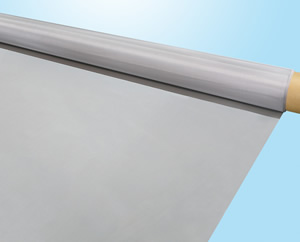
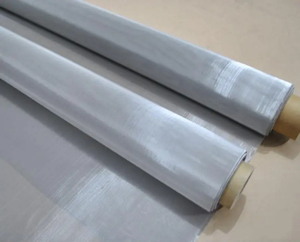
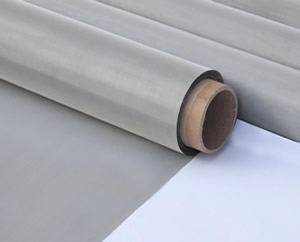
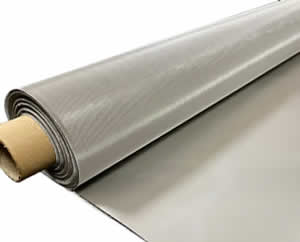
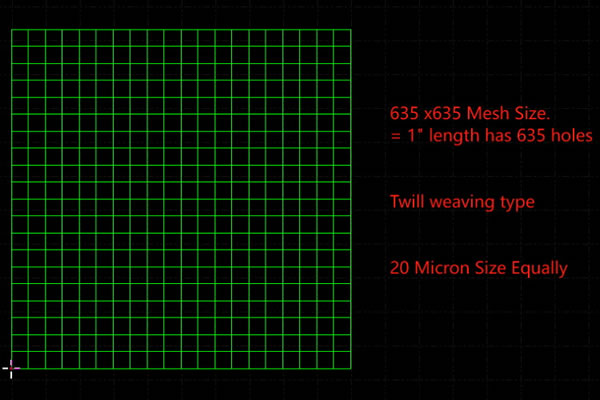
635 mesh stainless steel wire mesh is a high-precision twill weaving type woven mesh product, with its core parameter defined as having 635 mesh openings in both the horizontal and vertical directions within a one-inch (25.4mm) length, making it a high-mesh-count precision filter material. This product generally adopts a twill weave process to enhance the strength of the mesh surface and filtration stability. The common material is 316 stainless steel, suitable for precision separation scenarios in corrosive environments.
Detailed Specifications
Extremely high mesh count: 635×635 mesh size belongs to ultra-fine screens, typically used for precision filtration where stringent requirements are imposed.
Weaving method: twill weave
Extremely small aperture: Its aperture (opening size) is typically around 20 micrometers (μm) or even smaller (depending on the wire diameter). This size is approximately only 1/3 to 1/4 of the diameter of a human hair.
Extremely fine wire diameter: To arrange so many mesh holes within a unit area, the stainless steel wire used must be extremely fine, typically ranging from 0.03mm (30μm) to 0.04mm.
Material types: 316, 316L high-quality stainless steel wire
Wire diameter: 0.025mm 0.03mm 0.028mm usually
Features
High precision: With up to 635 meshes, the mesh is uniform and the filtration precision is extremely high, capable of intercepting tiny particles.
Strong corrosion resistance: Materials such as 316L provide excellent acid and alkali resistance and rust resistance, making them suitable for use in highly corrosive environments.
High strength: The stainless steel material endows it with high strength, tensile strength, and toughness, making it wear-resistant and durable.
High temperature resistance: 316L stainless steel can withstand relatively high temperatures and maintain stable performance in high-temperature environments.
Applications
(1) Chemical industry: used for screening and filtering of chemical raw materials, as well as filtering of corrosive liquids and gases.
(2) Pharmaceutical industry: In the process of drug production, it is used for liquid filtration, powder screening, etc., to ensure the quality of drugs.
(3) Food industry: It can be used for screening and filtering food raw materials, such as flour and fruit juice, in compliance with food hygiene standards.
(4) Aerospace: In the aerospace field, it is used for filtration and protection of precision instruments, with extremely high requirements for quality and performance.
(5) Scientific research field: commonly used in precision filtration and screening experiments in laboratories, as well as related components in scientific research equipment.
|


 StainelssSteel wire mesh